A Keepsake Page for the End of a Journey
Make a travel memory page from one route detail, one sensory impression and one small object, so a trip stays vivid without recording every stop.
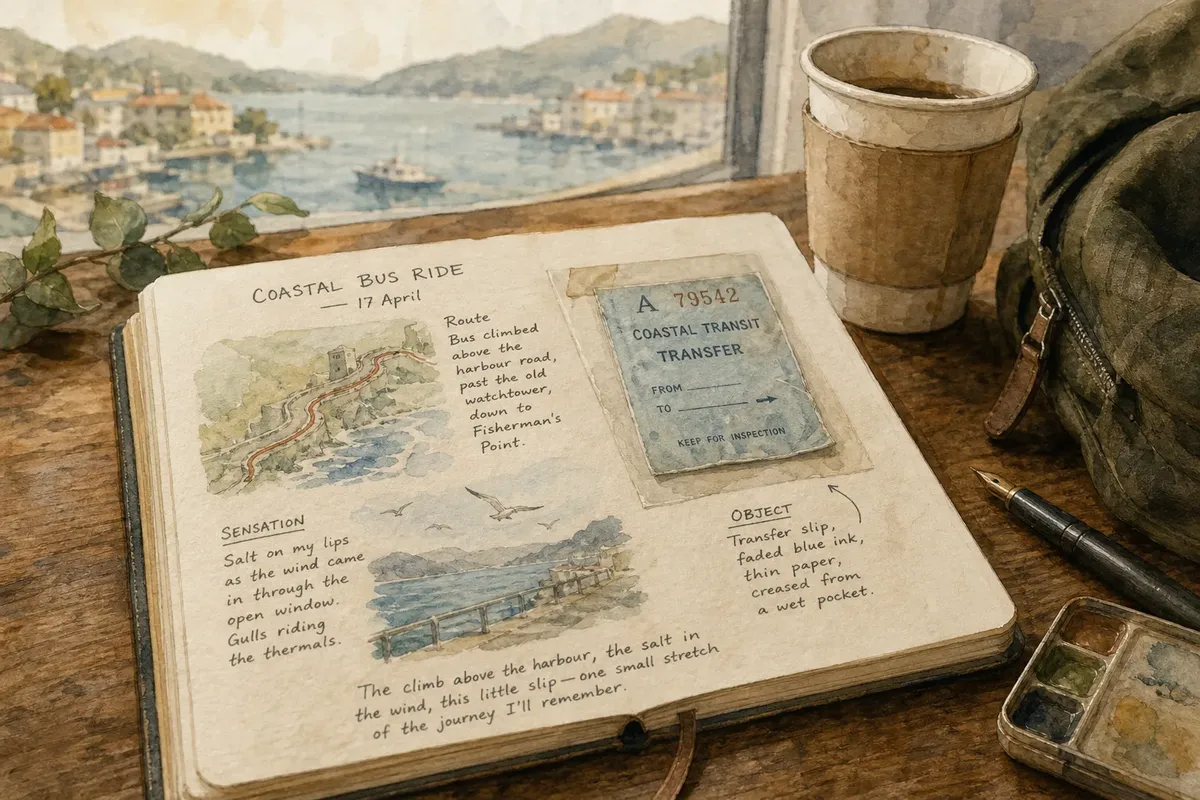
Make a travel memory page from one route detail, one sensory impression and one small object, so a trip stays vivid without recording every stop.
Memory · 6 min read
At the kitchen table, a train ticket lies beside a paper cup sleeve and a notebook that has stayed shut since the journey home. A travel memory page does not need to account for every station, meal or museum; it can hold a few details that bring the trip back into focus.
Choose one route detail, one sensory impression and either a small object or a description of it. Then decide how to arrange them. A compact page, a small narrative, or a collected fragment can all work; the right choice depends on what you want to remember and how much space you have.
Three useful approaches
These formats use the same three ingredients but give them different jobs. There is no need to fill the page evenly. A route may take a sentence, while a smell or object earns a little more room.
- The labelled page: Set down the route, sensation and object as separate notes, then add a short line connecting them. This suits anyone who prefers a clear structure or wants to finish while the details are still close.
- The miniature scene: Write one brief passage in which all three details meet. This suits someone who remembers a journey through a particular moment, rather than through a tidy itinerary.
- The collected page: Place a ticket, map scrap or other flat keepsake on the page, then write beside it. If the object is too bulky, describe its material, markings or use instead. This suits a person who thinks visually, or who would rather keep the actual object elsewhere.
Say you have returned from a coastal bus ride with a transfer slip in your coat pocket. You note that the route climbed above the harbour, remember the salt on your lips, and attach the slip or describe its faded blue ink. The expected result is a page tied to one distinct passage of the trip, not an inventory of the entire holiday.
Choosing the format
Start with the thing you can recall most clearly. If a route detail comes first, such as the ferry crossing from one island to another, the labelled page gives it a natural place. If a vivid moment arrives instead—the damp cuff of a coat after walking in rain—the miniature scene can hold the setting around it. If you have kept a small object, the collected page lets it anchor the writing without asking it to carry the whole memory.
Consider how you prefer to return to old entries. Separate notes are easy to scan, but can feel like filing. A scene may be more engaging to reread, though it asks you to shape the details into prose. An object offers a visual cue, but it need not be glued down or kept in the journal. A drawing, a transcription of a label, or a plain description can do the same work.
When torn between formats, choose the one that makes the first sentence easiest to write. The page is a keepsake, not a referendum on your literary abilities. A few honest details tend to serve better than a grand opening about the meaning of travel.
Finding the three details
For the route, look beyond the destination. Recall a turn, platform, bridge, footpath or change in direction: the narrow lane from the station to the guesthouse may tell you more than the name of the town. A rough line on the page can show the route if words feel cumbersome.
For the sensory impression, pick one specific thing. It might be the clatter of dishes in a roadside café, warm stone under a hand, or the smell of wet pine near a campsite. Avoid trying to cover every sense. One precise impression gives the page a point of entry; a catalogue can make it feel like a shopping list with better weather.
For the object, use something small and connected to the journey: a museum leaflet, a luggage tag, a leaf that has already dried, or a paper wrapper. If you do not have one, describe a meaningful item you saw or used. A description can include colour, texture, lettering or the reason it caught your attention.
Keeping the page legible
Give each detail enough space to be found again. A blank margin, a simple heading or a small hand-drawn arrow can connect the pieces without turning the page into a scrapbook project. If you attach a ticket or leaflet, leave room for the writing and avoid covering any text you want to read later.
Use whatever is already to hand: a pencil, a fine-tip pen, a notebook, or a notes app if the page will be made later. A phone photograph can help you remember an object’s appearance, but it need not become a substitute for the detail you noticed. The purpose is to make a memory retrievable, not to reproduce the trip’s paperwork.
Keep the entry narrow in scope. If another moment comes to mind, give it a separate page or a short note elsewhere. One page does not have to serve as the official record of the journey, a task no one has appointed it to perform.
Which approach fits?
What should go on a travel memory page?
Choose one route detail, one sensory impression and one small object or description. Add only enough context to make their connection understandable when you read the page later.
What if I did not keep a souvenir?
Describe an object you encountered, such as a ticket machine, a chipped café cup or a sign beside the road. Its appearance or use can provide the same concrete anchor as something you brought home.
Should I write the page during or after the trip?
Either can suit the task: jot down a fleeting detail while travelling, then assemble the page later, or write the whole entry once home. If you prefer to keep travel notes separate, leave a small reminder rather than trying to compose in a hurry.
How do I choose between the three formats?
Choose labelled notes for clarity, a miniature scene for a moment that unfolds in sequence, or a collected page when an object provides the strongest cue. If none stands out, use the format that feels simplest to begin.
A small record
A keepsake page is most useful when it preserves something particular that a broader account might overlook. The route gives the memory a direction, the sensory detail brings back its texture, and the object or description offers a point to return to. Leave some parts of the trip unrecorded. The unfilled space is not missing evidence; it is room for the journey to remain larger than one page.
More pages like this

The First Page Can Be a List of What Is Nearby
A nearby-objects journal entry gives a new page an easy starting point: use a short, timed…

Bound Notebook or Loose Pages? Choose by How You Return
Bound notebook or loose pages: compare portability, rearranging and revisiting to choose a journal format that…