Before the Diary: A Brief Look at the Commonplace Book
A commonplace book gathers passages and ideas by subject, not by date, so useful thoughts can meet again long after the day that first held them.
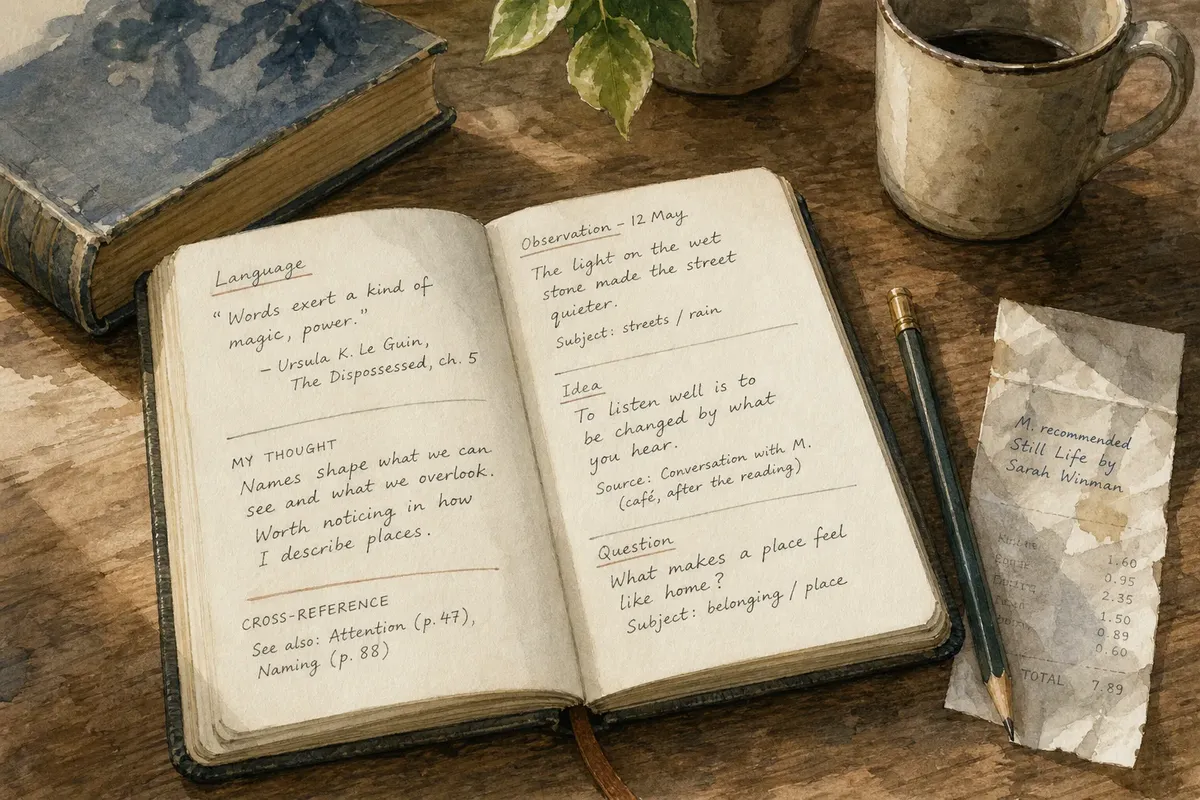
A commonplace book gathers passages and ideas by subject, not by date, so useful thoughts can meet again long after the day that first held them.
Journal Forms · 7 min read
A commonplace book is open on the kitchen table beside a library book, a pencil and a receipt someone meant to throw away. None of them belongs to today’s story. The notebook’s job is to keep the sentence from the book, the thought it sparked and perhaps the name of the person who said it. Unlike a diary, it does not need to explain what happened before breakfast.
That difference is small but useful. A diary usually follows time; a commonplace book follows interest. Its pages gather passages, observations and ideas that may be worth finding again, without asking them to form a continuous account of a life.
Collect, Don’t Chronicle
The old term commonplace book describes a personal collection of useful or striking material. The contents might include quotations, definitions, arguments, images described in words, or questions that have not yet found an answer. “Commonplace” here does not mean dull. It points towards the shared subjects and ideas people return to.
A diary entry might say that the bus was late, the rain got into a paper bag and a friend mentioned a book. A commonplace entry might preserve the friend’s recommendation, note the title and add why it caught the writer’s attention. One records the day’s sequence; the other extracts something from it.
The forms can overlap. A dated note may sit next to an undated quotation, and a line about a conversation may be worth keeping because of the idea inside it. The distinction is not a rule about what belongs. It is a question of what you want the page to do when you return to it.
Choose a Gathering Principle
Material needs a modest place to land. Without one, a collection becomes a pile of interesting scraps whose main shared feature is that they are difficult to locate. The organising principle can be loose, but it should help you remember where to look.
Some commonplace books use broad subjects such as “language”, “work”, “gardens” or “attention”. Others collect by source: passages from novels, things heard in conversation, ideas from walks. A simple index at the front can point to pages, while headings in the margins make a notebook easier to scan. In a digital app such as Apple Notes or Obsidian, tags and search can take on some of that work, though a tag is only useful if you remember what you called it.
Start with categories that already recur in your reading or thinking. A taxonomy designed before any material arrives tends to become a small administrative hobby. If a note could sit under several headings, choose one and add a cross-reference only when you have a practical reason to find it from elsewhere.
Keep the Source Attached
A passage without its source can become an attractive orphan. Record enough information to recognise where it came from: the author, title and, where useful, chapter or page. For a film, include the title and perhaps the scene; for a conversation, identify the setting or person if that detail is appropriate and you are comfortable keeping it.
Separate the quoted words from your own response. Quotation marks, a dash, or a clear note such as “my thought” can prevent them from blending together later. This is not fussy bookkeeping. After a few months, the mind is quite capable of crediting a sharp sentence to the wrong person, especially if the notebook is eloquent about it.
Keep quotations short enough to serve your purpose, and check the source if you plan to share them publicly. Copyright and quotation rules depend on context and local law, so consult a qualified professional if publication raises a specific legal question. For private use, careful attribution still helps you return to the original rather than treating your notebook as a substitute for it.
Make Each Note Retrievable
A good entry does not need to be polished. It does need a clue that will make sense to your future self. A brief heading, a subject word or one sentence explaining why the passage mattered can turn an isolated fragment into a usable note.
Consider what you might search for later. “A sentence about patience from the essay on pruning” is more findable than “nice line”. If the point is an idea rather than a quotation, write it in your own words and name the source that prompted it. That small distinction lets you see what you borrowed and what you made of it.
- For a quotation: copy the words accurately, mark them as a quotation and note the author and source.
- For an idea: summarise it in your own language, then add where it came from.
- For an observation: record the detail and the subject it belongs to, such as a plant, a street or a recurring sound.
- For an open question: write the question plainly, then add a subject heading so it does not vanish among unrelated notes.
These are not four compulsory entry types. They are ways to keep the collection legible without turning each page into a form to fill in.
Let Connections Develop
The pleasure of collecting often arrives later, when a new passage meets an old one. A note about a character’s silence may sit beside an observation about a quiet room; a phrase about work may return when a different author describes attention. The notebook need not announce a grand theme. It can simply place materials where you may notice their resemblance.
Say you keep hearing the word “threshold” in different settings: in a poem, in a conversation about moving house and in a museum label. You could file each note under “thresholds”, keeping the source beside it, and add a short line about what differs between the uses. The expected result is not a settled theory. It is a small cluster you can revisit, with enough context to see whether the connection still interests you.
Resist the temptation to explain every link as soon as it appears. A question mark or a brief margin note can preserve uncertainty. Commonplace books are allowed to contain ideas that never become essays, projects or wisdom. Some sentences are simply good company on the page.
Use the Format You’ll Revisit
A paper notebook makes copying and rereading tactile. A pencil is forgiving for marginal notes; a pen gives quotations a clear edge. A pocket notebook can catch a phrase away from home, while a larger one leaves room for source details and cross-references. Loose index cards suit a collection you want to rearrange, though they need a box or other home before they begin migrating around the room.
Digital notes make searching easier and can hold links, scans or audio references. A plain text file is durable and uncomplicated; a notes app is convenient if it already fits the way you work. The trade-off is that a digital collection can accumulate faster than you read it. Choosing a format is less about finding the perfect system than about making retrieval feel easier than abandoning the note.
Do not copy a whole article or chapter just because a sentence caught your eye. Keep the relevant passage, its source and your reason for saving it. The limit is practical as much as ethical: a compact note is more likely to be read again than a second, unofficial version of the book.
Commonplace Book Questions?
How is a commonplace book different from a diary?
A diary generally records experience in time order, while a commonplace book gathers material around subjects, sources or interests. They can share a notebook, but the purpose of each entry differs.
What should I collect in one?
Keep passages, ideas, observations, definitions or questions that you may want to revisit. Add enough context to remember why the item mattered and where it came from.
Does a commonplace book need an index?
No, but a simple index or a few consistent headings can help once the collection grows. If you use digital notes, descriptive titles and a small set of familiar tags may do the same job.
Can I keep one digitally?
Yes. A notes app, plain text file or digital notebook can all work if you can search and preserve source details. Choose the format you are likely to reopen, not the one with the most elaborate filing options.
Return Without Ceremony
Rereading need not become a scheduled audit. Open the book when a subject comes up, when you finish something worth collecting, or when you need a thought to sit beside another thought. Add a brief mark beside entries that still matter; leave the others alone. A commonplace book earns its keep through useful returns, not through perfect coverage.
For a commonplace book, the most practical test is whether a saved idea can be found and understood later. Keep the source near the words, give the note a sensible path back to itself, and allow the collection to remain partial. A notebook need not account for every day to hold a great deal of a life’s attention.
More pages like this

The First Page Can Be a List of What Is Nearby
A nearby-objects journal entry gives a new page an easy starting point: use a short, timed…

Bound Notebook or Loose Pages? Choose by How You Return
Bound notebook or loose pages: compare portability, rearranging and revisiting to choose a journal format that…