The First Page Can Be a List of What Is Nearby
A nearby-objects journal entry gives a new page an easy starting point: use a short, timed routine to notice your surroundings without forcing a story.

A nearby-objects journal entry gives a new page an easy starting point: use a short, timed routine to notice your surroundings without forcing a story.
Getting Started · 5 min read
The kettle clicks off beside a chipped mug, and the blank journal page remains blank. A nearby-objects journal entry offers a smaller beginning: write down what you can see, one ordinary thing at a time. There is no story to invent and no requirement that the mug mean anything.
This simple inventory gives attention somewhere concrete to land. Try it as a brief routine across a week, using the same general approach but letting the room, the hour and your energy vary. The aim is not to produce an impressive page. It is to make starting feel possible.
Choose a small patch
Pick a place you can see without rearranging anything: one corner of a desk, a kitchen counter, a bus stop bench or the view from a window. Keep the area small enough that you can scan it comfortably. A whole room can become a tedious catalogue of furniture; one patch tends to offer enough detail without requiring an inventory of the building.
Use whatever is already to hand. A paper notebook and pen are straightforward, while a notes app such as Apple Notes or Google Keep works if your phone is nearby. Avoid turning preparation into a separate project. The page does not need a title, a special pen or a carefully curated collection of objects.
The first three days
For the first three days, write a short list at a convenient moment. Leave it at that; a modest entry is easier to repeat than a ceremony with elaborate rules.
- Day one: Name five things in one small patch. Use plain nouns: coaster, envelope, spoon, key, crumb.
- Day two: Choose a different patch and list what is closest to you. Include an object you had not deliberately noticed.
- Day three: Return to a familiar place. Record one change, if you see one, and otherwise make a fresh list.
The number is a loose boundary, not a test. If five objects is awkward, write fewer. If you have more to say, add a phrase about colour, texture or position rather than making the list longer for its own sake. “Blue thread caught under the notebook” gives the eye something specific to remember.
Add one layer
On the next two days, keep the inventory and add one sensory detail. Choose something visible, such as a crease in a paper bag, or something you can hear from where you sit, such as footsteps in the corridor. You are not trying to reproduce the whole scene; one detail is enough to move the list beyond a set of labels.
Say you are sitting at a library table and your page begins with “lamp, book, water bottle”. You add “a strip of late light across the cover”. The list now holds a small moment without requiring you to explain why it mattered. If the light moves, that is a detail too, though the journal need not file a formal report.
Keep observation separate from interpretation when that feels useful. “The spoon is sticky” describes what you notice; “I have failed at being organised” is a verdict. The second sentence may reflect a feeling you want to explore, but it does not have to enter the list. Starting with what is present can leave you free to decide later whether the page calls for anything else.
Let repetition help
Familiar places offer a quiet comparison. A windowsill may hold the same plant pot and post on several days, while the light, the unopened letter or the condensation on the glass changes. This is not an assignment to find novelty. Repetition can make small differences easier to see, and an unchanged scene is still available to write down.
If you return to the same patch, avoid treating each entry as a continuation that must advance. You can simply list what is there again. When a difference catches your attention, name it plainly: the chair has turned, the post has been moved, rain marks the sill. Leave a blank if nothing else comes.
When should you write?
How long should an entry take?
Let the entry stay short enough to fit an ordinary pause. You might write a handful of nouns and one detail, then stop when the page feels complete for that moment.
What if the room looks dull?
Choose a closer view: the grain of a table, the contents of a pocket or what is visible through a shop window. An unremarkable scene still contains shapes, surfaces and positions, which is plenty for a first entry.
Should you include feelings?
Include them if they arise, but do not require them. Naming what is nearby can be useful on its own; the list does not need to become a confession to count as journalling.
Finish the first week
For the final two days, choose whichever version felt easiest: a plain inventory, an inventory with one sensory detail, or a return to a familiar place. On the last day, look back over the week and underline one object or detail you would otherwise have forgotten. Do not grade the entries for depth. A small recurring mark can be more useful than a grand plan you avoid.
If you miss a day, continue the next time you have a page and a view. There is no need to recreate the skipped entry or extend the routine as a penalty. The nearby-objects journal entry works because it can begin in the room you are already in, with the attention you have available. A blank page often becomes less imposing once the first noun is down.
More pages like this

Bound Notebook or Loose Pages? Choose by How You Return
Bound notebook or loose pages: compare portability, rearranging and revisiting to choose a journal format that…
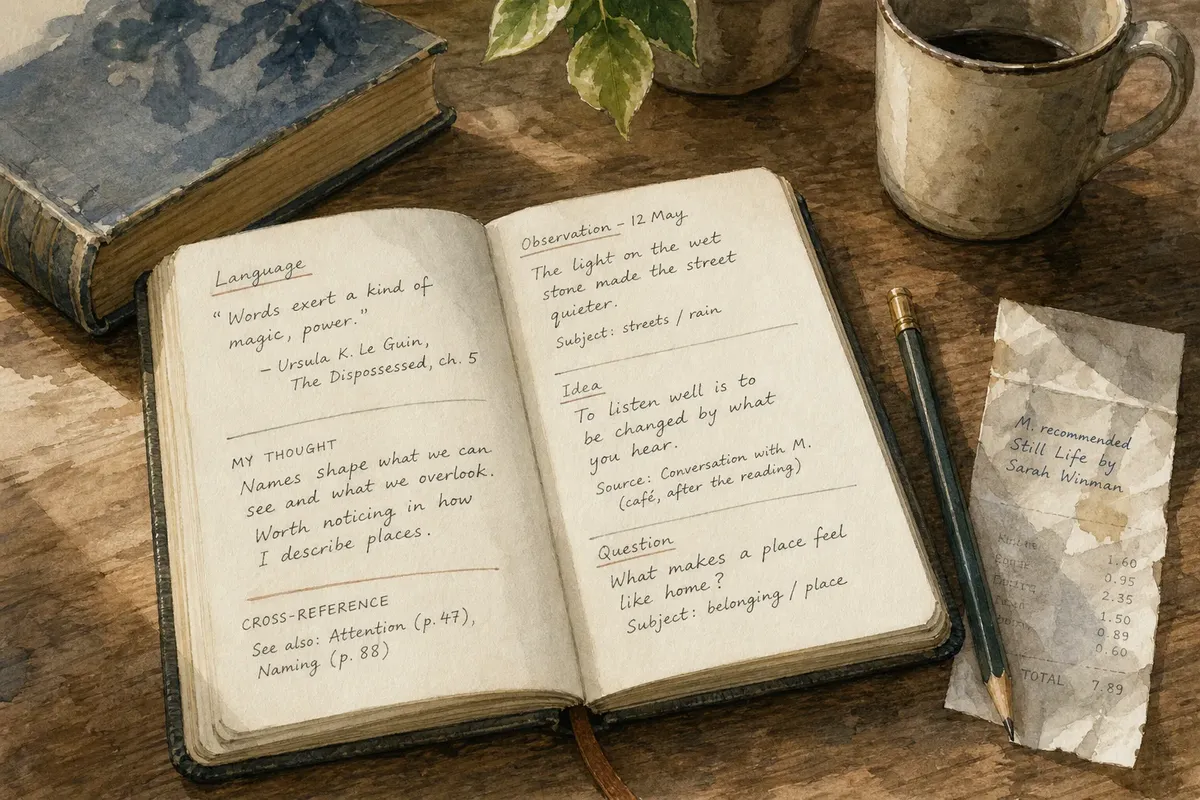
Before the Diary: A Brief Look at the Commonplace Book
A commonplace book gathers passages and ideas by subject, not by date, so useful thoughts can…