The Prompt Trap: When a Question Makes Every Entry Sound Alike
Repeating journal prompts can flatten your entries. Learn how to vary the angle of inquiry so ordinary details lead to fresher, more distinct pages.
Repeating journal prompts can flatten your entries. Learn how to vary the angle of inquiry so ordinary details lead to fresher, more distinct pages.
Observation · 7 min read
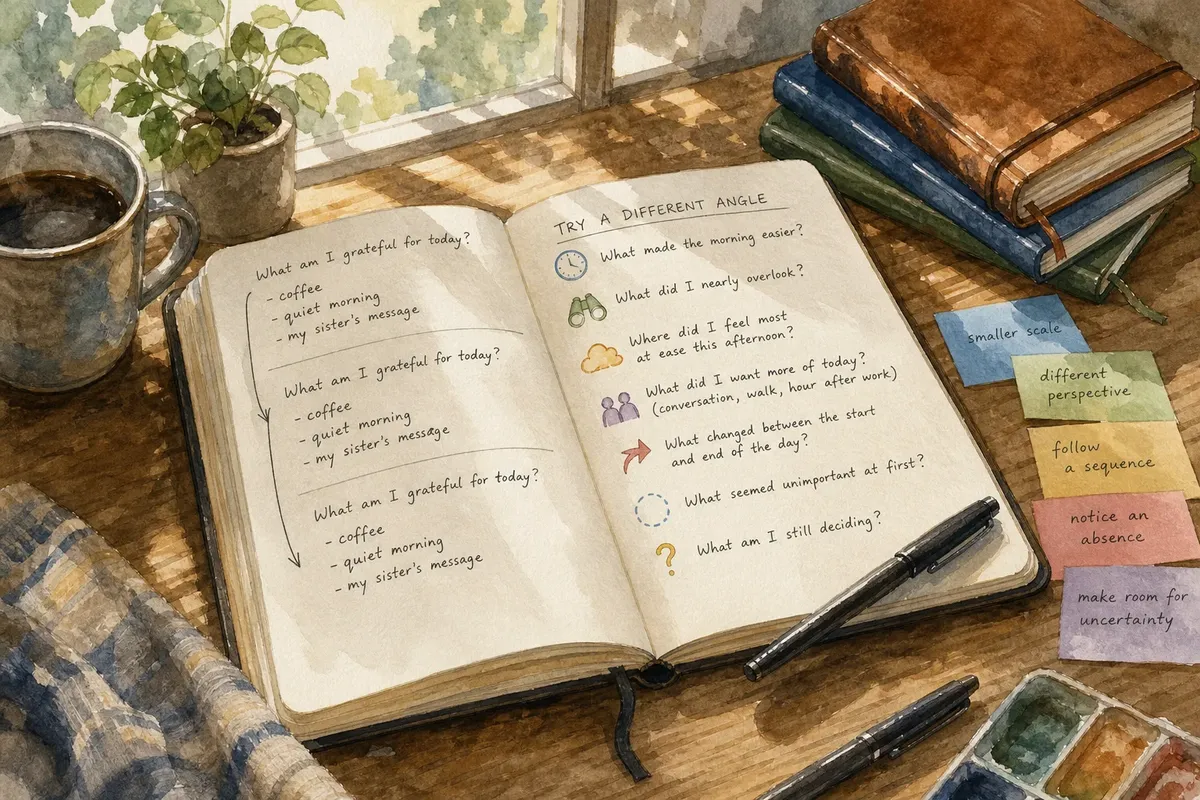
You open your journal, see the familiar question “What am I grateful for today?” and write “coffee, a quiet morning, my sister’s message”. Tomorrow, the same question produces a cousin of the same list. The prompt has not failed exactly; it has made the answer too easy to predict. Repeating journal prompts can flatten your entries, and the remedy is often to change what you are looking at rather than add more detail.
When answers repeat
A narrow question points towards a narrow kind of answer. “What went well today?” tends to collect pleasant events. “What was difficult?” tends to collect obstacles. Used occasionally, either can help you notice something. Used as the regular entrance to every page, each turns the day into the same small filing cabinet.
The cause is usually the prompt’s boundary, not a failure of imagination. A question such as “What am I grateful for?” invites a list of valued things, but it does not ask how gratitude appeared, what complicated it, or what went unnoticed. Reaching further inside the same answer can produce more words without producing a different entry.
Try keeping the subject but changing the angle. Instead of listing what you appreciated, ask what someone did that made the morning easier, what you nearly overlooked, or what you would miss if it disappeared from the day. Each question directs attention towards a different kind of detail. The point is not to make every page profound; a journal has no need to audition for a quotation calendar.
When the page turns generic
Some prompts invite answers that could belong to almost anyone: “What makes me happy?” or “What do I want from life?” Their scale is so large that a writer may retreat to familiar abstractions: family, balance, less stress. These may be true, but the words can sit on the page without telling you much about this particular day.
Usually, the prompt has asked for a general opinion when a specific encounter would be easier to recall. Shrink the time or place, or ask about a moment rather than a category. “When did I feel most at ease this afternoon?” gives the mind a scene to search for. “What did I want more of today?” can also be narrowed to a conversation, a walk or the hour after work.
Say you have answered “What made me happy?” with “being outside” several times. You might instead ask where you were, what caught your eye, or what you were doing just before you noticed the change in mood. You could then write about rain tapping on the bus shelter while you waited for the number 38. The answer remains modest, but it belongs to a day rather than to a slogan.
When detail becomes padding
A common response to a dull entry is to demand more description: more sensory detail, more explanation, more sentences. That can help when the page is thin because the writer has skipped over a vivid moment. It does less when the prompt keeps asking for the same kind of response. A longer list of familiar answers is still a familiar list.
Look for a different relationship to the subject instead. A moment can be approached through contrast, sequence, uncertainty or consequence. Ask what changed between the start and end of an event, what surprised you, what you assumed at first, or what small thing altered the mood. These questions do not require ornate prose; they give the entry a new direction.
For example, if “What annoyed me today?” keeps producing a complaint about a crowded train, try asking what you expected before boarding or what you did while waiting for a seat. The entry might shift towards the relief of finding a window, or the brief exchange with a stranger. The annoyance need not be denied. It simply stops being the only available lens.
When prompts feel like homework
A prompt can also flatten a journal by setting a task that feels too demanding. “Describe your deepest fear” may be a poor fit for an ordinary Tuesday, and “Write about the most important thing you learned” can make a routine day seem unworthy of a page. If the question produces dread or a blank stare, that is useful information about the question’s scale.
Reduce the demand rather than negotiating with it for half an hour. Ask for one moment, one object, one exchange or one thing you are unsure about. A smaller question can still open a thoughtful entry, and it leaves room for the day to be ordinary. Journaling is not improved by making a quiet evening defend its significance.
Another option is to answer sideways. If a direct question feels too exposed, write about what you noticed in someone else’s words, what you avoided saying, or what you would tell a friend in the same situation. This does not have to become a coded confession. It is simply another route into the material.
Which angle helps most?
How do I know a prompt has become repetitive?
Look across several entries and notice whether the same opening, examples and conclusion keep returning. Repetition is not automatically a problem, but if you can predict the answer before you begin, the question may be directing you too narrowly.
Should I stop using a prompt that works?
No. A reliable prompt can be useful when you want a quick entry or a steady point of reference. Keep it, but use it as one option rather than the only doorway into the day.
What if I cannot think of a new angle?
Change one feature of the question: its time span, point of view, scale or sense of certainty. Moving from “What mattered today?” to “What seemed unimportant at first?” may be enough to unsettle a rehearsed answer.
Can I leave a prompt unanswered?
Yes. You can write that the question does not fit today, then note what you would rather attend to. A journal prompt is an invitation, not a form that needs every box filled in.
A small prompt rotation
When a familiar question starts pulling the same response from you, keep a few alternate angles nearby. They need not become a system or a new obligation. Choose the one that makes you curious, or alter its wording until it points towards something you have not already written down.
- Change the scale: Move from “What is going well?” to “What went well in the last hour?”
- Look for contrast: Ask what felt different from what you expected.
- Follow a sequence: Begin with what happened just before or just after a moment.
- Notice an absence: Ask what you did not have to think about today.
- Borrow another viewpoint: Consider what a friend might have noticed about the same scene.
- Make room for uncertainty: Ask what you are still deciding, rather than what you have concluded.
These variations help because each changes the kind of attention the page asks for. You might keep the same subject—work, family, a walk home—while turning from evaluation to sequence, or from a conclusion to a question. The subject can stay familiar; the entry need not arrive at the same answer.
Return to the day
If your journal has begun to sound like itself on repeat, treat that as a prompt-design problem, not a verdict on your powers of observation. A question can make one part of a day easy to see and leave the rest outside its frame. Change the frame: ask about a pause instead of a result, an expectation instead of a feeling, or a detail you nearly missed instead of the thing you already know matters.
The next time you reach for a familiar journal prompt, notice whether it makes you curious or merely tells you what to write. If it is the latter, alter the angle and follow the new question wherever it leads. Sometimes the fresh entry is not a bigger answer. It is a different thing noticed on the way to one.
More pages like this

The First Page Can Be a List of What Is Nearby
A nearby-objects journal entry gives a new page an easy starting point: use a short, timed…

Bound Notebook or Loose Pages? Choose by How You Return
Bound notebook or loose pages: compare portability, rearranging and revisiting to choose a journal format that…