Notice One Ordinary Object for Three Minutes
A three-minute object observation exercise turns vague impressions into concrete notes and helps you shape them into a scene without forcing a meaning.
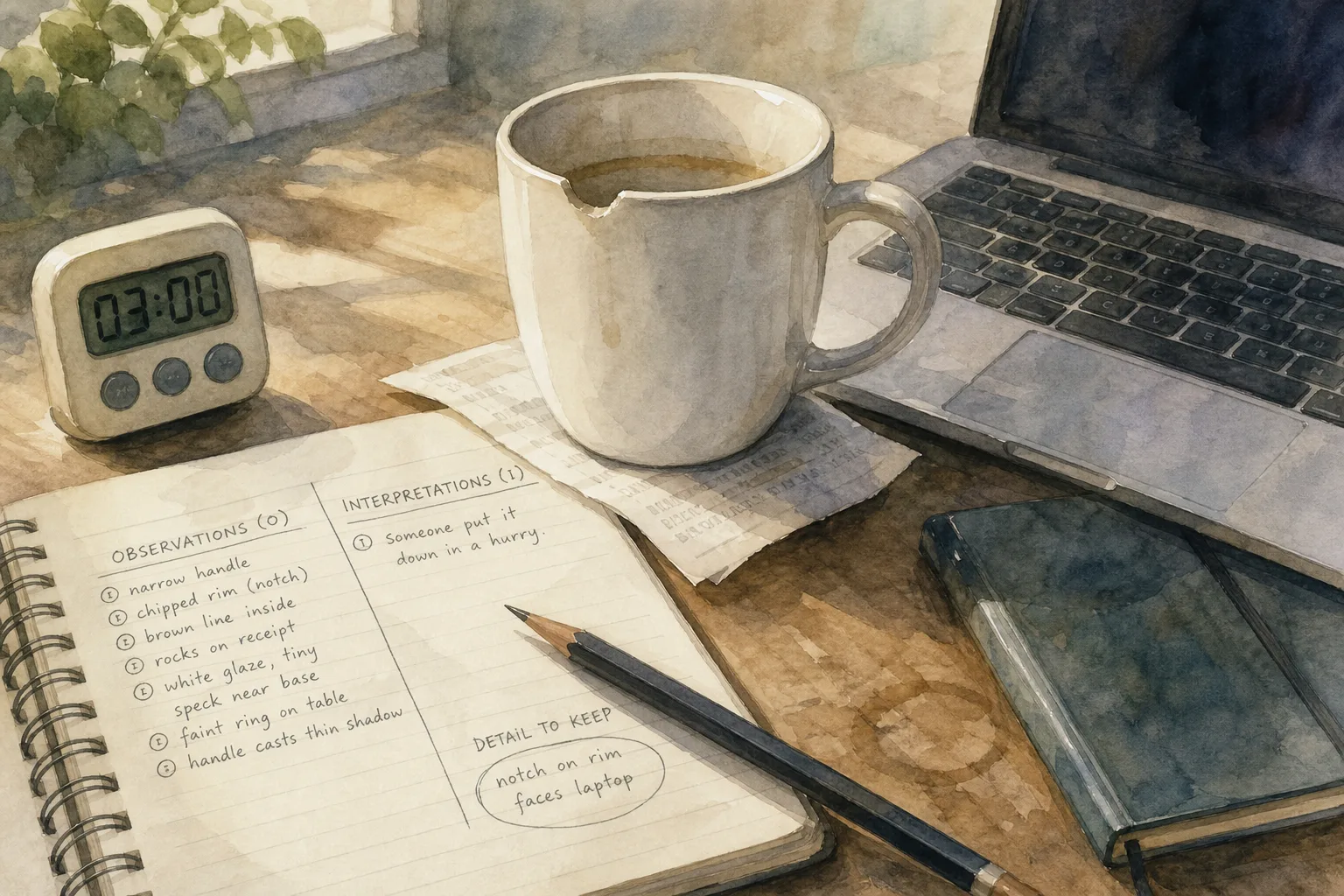
The common mistake in a three-minute object observation exercise is deciding what an object means before looking closely at it. A mug becomes “comforting” before you notice its chipped rim, tea stain or faint ring on the table. Set a timer for looking and note-making; when it rings, sort what you saw from what you inferred.
Choose a small object within reach, open a notebook and set a timer for three minutes. Write continuously, in fragments or sentences, about what you can observe. The timer is a boundary, not a demand for polished prose.
Which object suits a three-minute observation exercise?
Choose something still, accessible and safe to handle: a pencil, key, spoon or paper clip. A wooden pencil offers edges, colour, wear and a familiar relationship to the hand. Familiarity helps because you need not pause to identify it or look up how it works.
Keep a fragile or shared object where it is and observe it from there. You do not need to turn over a framed photograph or pick up someone else’s belongings. If an object carries a strong personal history, choose something less loaded for this pass; attention does not require an excursion into autobiography.
What should I write during the three minutes?
Stay with the object and its immediate setting. Note its position, what touches it, and visible marks or wear. Change your angle only if you can do so safely and without disrupting anything. A spoon in a drawer has different surroundings from one balanced across a cup.
If your attention stalls, use one prompt and keep looking:
- Observe the outline; if it is hard to describe, compare it with a familiar shape and record the closest match, or describe its edges one by one.
- Check for scratches, stains, worn or smooth areas; if no mark stands out, describe the clearest colour or texture instead.
- Compare the view from above and the side; if little changes, note what remains the same, or return to the angle with more visible detail.
- Observe what the object touches; if it touches nothing else, record where it rests, or note the surface immediately beneath it.
- Listen only if moving the object is safe and appropriate; if it is not, leave it in place and note any sound already present, or skip sound entirely.
- Notice which detail catches your eye twice; if none does, choose the part easiest to describe precisely, or return to the object’s position.
Use words that point to something observable. “The metal feels cold” records a sensation; “the key looks lonely” gives it a mood. You can keep both kinds of note, but mark the difference after the timed pass. Treat the page like a tray of mixed objects: first gather what is there, then sort what belongs in different piles.
When should I separate observations from interpretations?
Keep writing until the timer rings, including any impressions that occur to you. Then stop, reread the notes and mark observable details O and interpretations I. This order lets you preserve the continuous act of looking without mistaking a hunch for evidence.
If you wrote “neglected”, ask what prompted the word. Dust in a groove, a frayed label or a crack can be marked O; “neglected” is an I, one possible reading of those details. A worn patch might suggest frequent use, an awkward grip or simply the way an object is set down. The object can support a possibility, not disclose a person’s motives.
What should I do when the timer rings?
Stop writing, even if the last sentence is unfinished. Mark observations O and interpretations I, then circle one distinctive detail. The timed pass is complete. If you want to continue, use the notes for a separate drafting pass rather than extending the observation timer by accident.
Say you choose a chipped white mug beside a laptop and set a three-minute timer. In this invented situation, the starting materials are one mug, one laptop, one folded receipt, a notebook and a timer. You write that the handle is narrow, the rim has a notch, a brown line sits inside the cup, and the mug rocks on the receipt; you also write, “someone put it down in a hurry”. When the timer rings, mark the notch, line and rocking O, and the sentence about haste I. The resulting decision is to keep the physical details and treat haste as a possible reading, not a fact. If the receipt is moved during a later drafting pass, note that as a separate action rather than silently changing the original observation.
What questions come up after the timer?
How do I choose which details to keep?
Keep details that are specific or connected to one another. “A blue cup” is broad; a pale arc where its handle meets the body is easier to picture. If two details compete, retain the one that most clearly distinguishes this object from another like it.
How do I move from notes to meaning?
Ask what the details suggest, then point to the details behind that thought. A worn patch near a handle may suggest repeated use, but it cannot tell you who used the object or why. Phrase the reading as a possibility.
What if I run out of things to write?
Stay with the object and change your angle, if that is safe, or inspect how it meets another surface. If nothing new appears, return to a detail already on the page and describe exactly what makes it distinctive. The timer still marks the end of the pass.
Can I do the exercise without a timer?
Yes. The title refers to the timed version, not a rule for every attempt. If a countdown makes you tense, write until you have filled a few lines, then stop and mark one observation and one possible interpretation; that is an untimed variation, not the three-minute version.
How can the notes become a piece of writing?
Build a sentence around a relationship between details rather than choosing the most striking feature by default. A scratch beside a key’s worn bow might lead you to describe how the key turns in a lock; a spoon’s smooth handle and the drawer it rests in might suggest a small scene of use. The object can remain part of a larger moment.
For the mug notes, you might begin: “The chipped rim faced the laptop, while the folded receipt made the mug rock under my hand.” The sentence uses the notch and uneven base without claiming to know why the mug was left there. You could add a tentative thought about hurried work, or leave the scene with its physical details.
Before drafting, separate what you observed from the meanings you supplied. Keep details that make the scene exact; use an interpretation only if it adds something the physical description cannot. If the writing concerns a real person or event, an object is not proof of motives you cannot know.
Return to a three-minute object observation exercise when a page feels vague or you need a bounded way to begin. Set the timer, stay with one object and leave the sorting until it rings. The useful result may be one precise detail that gives the next sentence somewhere to stand.
Keep the page turning
The First Line Can Be a List
A list of writing prompts can ease the pressure of a polished opening. Choose a focused…
Pocket Notebook or Desk Book: Choose by Where You Write
Choose a pocket notebook or desk book by matching portability, page space and writing position to…