The First Line Can Be a List
A list of writing prompts can ease the pressure of a polished opening. Choose a focused question, follow its next sentence and give the page a direction.
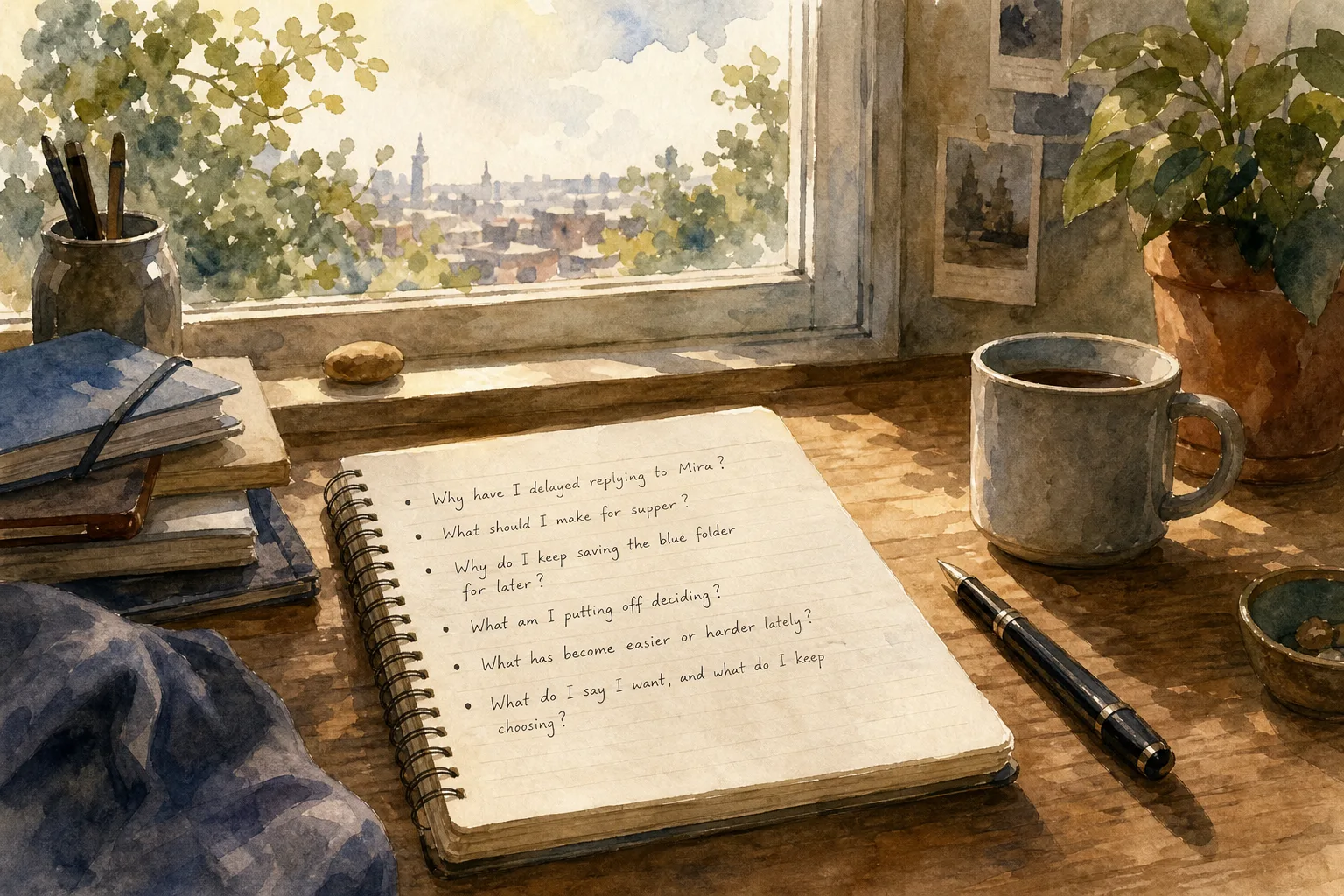
The common mistake with a blank page is asking the first sentence to explain the whole piece. That pressure can stall a notebook entry before it starts. A list of writing prompts offers a smaller opening: jot down several questions, choices or changes, then pick one to follow.
The list is not a catalogue of things around you. It is a short set of possible directions for a thought, like a ring of keys: you need one that turns, not a speech about the ring.
Why use a list of writing prompts?
An opening sentence can feel like a commitment to a subject, tone and destination all at once. A list lets you postpone that decision. You can put several unfinished possibilities on the page without pretending to know which one matters yet.
Keep entries active and open-ended. “Why do I keep postponing the call?” gives you a question to pursue. “Write about the phone” names a subject but gives you little to do. A useful prompt contains some friction: a decision you have avoided, a change you have noticed, or two things that do not quite fit together.
What belongs on the list?
Choose entries that lead towards a question, a small decision or a contrast. They might come from a task on your mind, a conversation you are still turning over, or a subject you have been avoiding. Keep each one short enough to scan without explaining it first.
- An unanswered question: What am I putting off deciding?
- A change: What has become easier or harder lately?
- A contradiction: What do I say I want, and what do I keep choosing?
- A small decision: What can I settle today, and what can wait?
- An unfinished thought: What have I nearly said but left unsaid?
- A point of resistance: Which subject do I keep steering away from?
These are starting points, not demands for confession. If an entry feels too personal, leave it alone. If it is too broad, add a limit: turn “work” into “one decision at work I have delayed”.
How do you choose a prompt?
Read the list once and mark the entry that offers the clearest next sentence. It need not be the most serious item. Choose one you can approach without inventing a grand explanation.
Say you have a notebook open after an ordinary afternoon. You write three invented prompts: “Why have I delayed replying to Mira?”, “What should I make for supper?”, and “Why do I keep saving the blue folder for later?” You choose the first because it suggests a next question: what makes the reply difficult? You write a few sentences about being unsure how to answer a message that asks for a decision. The resulting paragraph stays with that uncertainty; supper and the folder remain available for another day.
If none offers a next sentence, narrow each one. “My future” is a large subject; “What do I need to decide before Friday?” gives the page a boundary. If that still feels demanding, choose something lighter. A writing prompt is not a summons.
What should follow the first line?
Answer the selected question in plain language, then ask what makes that answer incomplete. You might write what you believe, what complicates it, or what you have not decided. The aim is to follow a thought, not to prove a point.
After “What am I putting off deciding?”, for instance, name the decision. Then write what makes either option difficult. That creates movement through reasoning rather than adding unrelated description.
If a claim sounds too neat, hold open another possibility. “I am avoiding it because I dislike conflict” might be part of the answer; perhaps you are also waiting for information. You do not need to settle the matter in the first paragraph.
What if choosing a writing prompt feels difficult?
How many prompts should you write?
Write a handful, enough to give yourself a real choice without turning the exercise into a catalogue. If you keep adding entries instead of selecting one, stop and mark the prompt with the clearest next question.
What if every subject feels too personal?
Choose something low-stakes, such as a routine or a postponed task. If it still feels uncomfortable, switch subjects; the page does not require disclosure.
Can a topic work as a prompt?
Yes, but give the topic a point of entry before you begin. “Work” might become “What part of work am I finding difficult to explain?”
Should you edit the list before choosing?
Correct an entry if you have written it inaccurately, but do not polish it for its own sake. If it is unclear, narrow it or turn it into a direct question, then choose.
How can you keep the exercise manageable?
Use the notebook or sheet of paper already within reach. Write the date if it will help you find the entry later, make a list, and select one prompt. You do not need a special pen, a quiet room or an entire page to yourself. The furniture can remain innocent.
Keep the first pass separate from revision. First, list possible directions. Next, mark one and follow it for a few sentences without correcting every phrase. If you lose the thread, return to the question you chose and write what you do not yet know.
Use these checks to decide what to do next:
- Broad subject: Check whether you can name a next sentence for an entry such as “family”. If you cannot, narrow it to one question; if you can, select it and begin.
- Decision with clear options: Check whether you can state the options. If you can, write what makes the choice difficult; if you cannot, turn the entry into a question about what remains unclear.
- Too personal: Check whether writing about the entry feels unwelcome. If it does, switch to a routine or practical subject; if it does not, keep the prompt and write only what you are comfortable putting on the page.
- Several promising entries: Check which one offers the clearest next sentence. If one stands out, mark it; if none does, choose the least demanding and write a brief response.
- Growing list: Check whether each added entry offers a genuinely different direction. If it does, add it; if you are adding entries to avoid choosing, stop and mark one.
- A claim that sounds final: Check whether you can name a qualification. If you can, add it; if you cannot, treat the claim as provisional and write the next sentence about what remains uncertain.
Where can a list lead?
A list can open a journal entry, a letter you are not ready to send, or a longer piece that begins with a question. Once you have followed one line of thought, decide whether it has enough substance to continue. You can also stop after a paragraph; an unfinished thought is not a clerical error.
If the first subject dries up, return to the remaining prompts and choose another. The second choice does not invalidate the first. It gives the page a different direction.
When you need a beginning, write a few questions or decisions rather than demanding a polished opening. Choose the one with a clear next sentence and follow it. A list of writing prompts can give the page a direction before you know what the whole piece will become.
Keep the page turning

Pocket Notebook or Desk Book: Choose by Where You Write
Choose a pocket notebook or desk book by matching portability, page space and writing position to…

Five Prompts for Describing a Familiar Room
Five prompts for describing a familiar room turn a flat inventory into a focused scene, with…