Pocket Notebook or Desk Book: Choose by Where You Write
Choose a pocket notebook or desk book by matching portability, page space and writing position to your routine, so each kind of note has a suitable place.
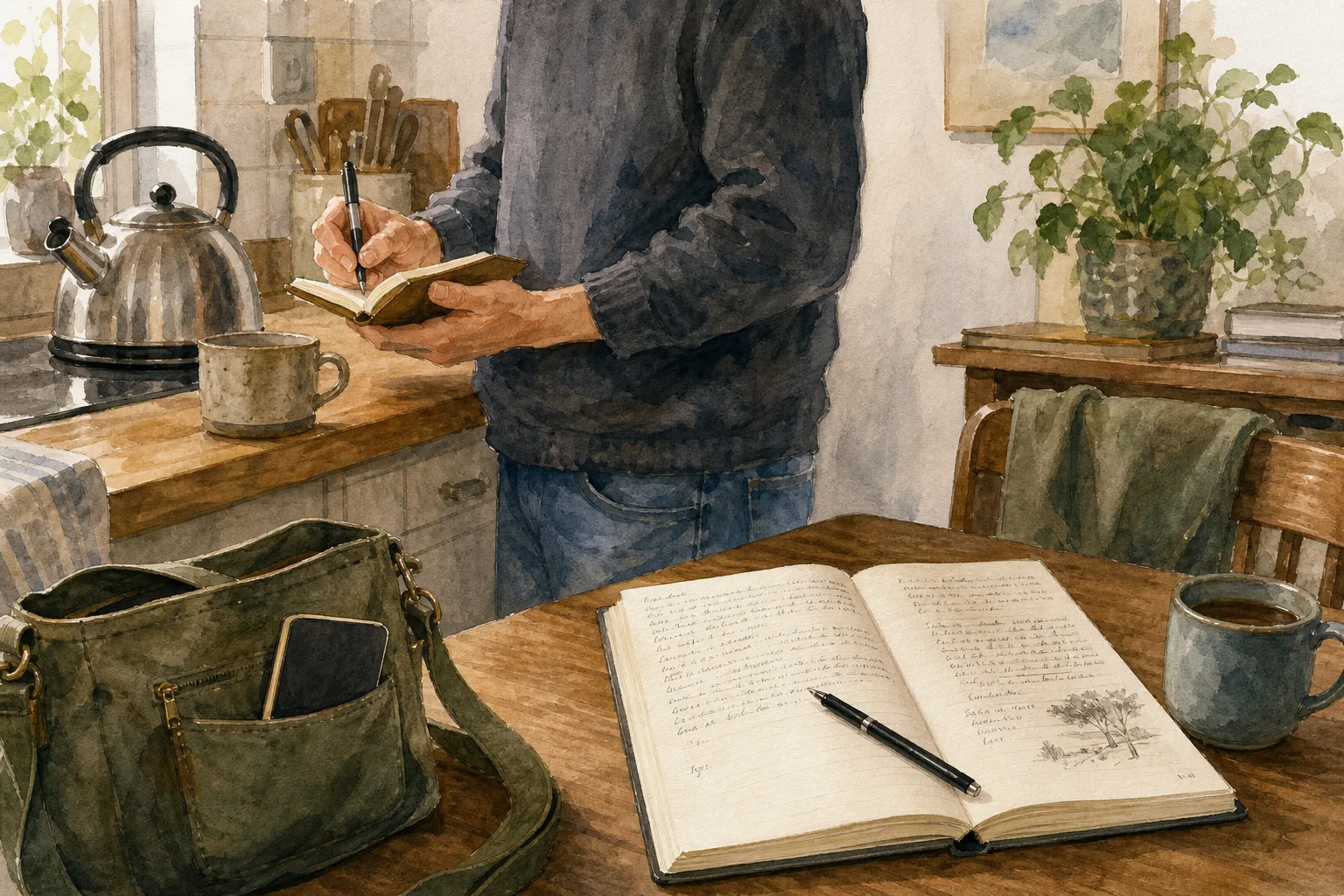
The common mistake is choosing a pocket notebook or desk book by its page size alone. The cost is a book that is awkward to carry or too cramped for the notes you actually make. Start with where you write, then consider the page.
Where does your writing happen?
Think of the places where a thought becomes a note: a kitchen counter, a train seat, a waiting room or a desk. Standing, sitting and leaning over a surface all change how comfortably a notebook can be held and opened.
For a few ordinary days, notice the setting when you want to write. A brief phone note or a scrap of paper can record the location and the kind of entry without turning the habit into a survey. You are looking for useful distinctions, not a ledger.
How do portability and page space compare?
A pocket notebook suits brief entries made away from a stable surface. It can fit in a coat pocket, small bag or apron, and is easier to have with you between places. The trade-off is limited room for long sentences, large handwriting, sketches or side notes.
A desk book offers more space for paragraphs, revisions and thoughts that need to sit beside one another. It is less convenient to carry, and may be out of reach when you are away from your usual writing place. If most writing happens at a table, that extra room may matter more than portability.
Think about the notes you make now, rather than an imagined future routine. Brief observations and reminders generally need less room than a passage with corrections or a sketch. Handwriting matters too: large letters, generous spacing and frequent edits can make a small page feel crowded.
Will it work in the position where you write?
A notebook that springs shut can be irritating when you are writing one-handed or leaning over a counter. If possible, open it at several points and see whether the pages stay open enough for your hand and pen. A desk book often rests more easily on a table; a pocket notebook may be simpler to hold, but uncomfortable near the binding.
Check the paper with your usual pen or pencil. If the ink feathers, the pencil smudges or the surface drags, try a different paper before settling on the format. A good page is rather like a clear patch of table: useful only if it is available where the work happens.
Which format fits these common situations?
Is a pocket notebook better for writing on the move?
It is often more convenient for brief notes away from a stable surface. Choose one that fits the pocket or bag you carry and leaves enough room for your ordinary handwriting.
Is a desk book better for longer writing?
It can suit paragraphs, revisions and margin notes, particularly if you write in one place. Its drawback is being elsewhere when you want to capture something on the move.
Can one notebook serve both settings?
Yes, if you are willing to carry it and its page accommodates the entries you make. A middle-sized book trades some pocketability for room, without matching either a small book’s convenience or a desk book’s space.
Should paper decide the format?
Paper feel matters when your usual pen feathers or your pencil smudges. Settle the likely size and setting first, then check the paper in a format you can comfortably use.
What should you check before choosing a pocket notebook or desk book?
- Carry: Put each book in the coat pocket or bag you actually use. If one fits comfortably, favour it for writing on the move; if neither fits, consider a smaller book or keep a desk book in one place.
- Typical entry: Write a usual brief note and date in each. If the words remain legible, that page works for short entries; if they crowd the edge, choose a larger format or reserve the small book for fragments.
- Long passage: Write a sample paragraph in each. If you can add a correction without crowding, it can serve longer writing; if not, favour the desk book or keep longer passages for a table.
- Extra marks: Add a location, small sketch or margin comment you commonly use. If each remains clear, the page has room for those additions; if they collide, choose a larger page or omit the least useful mark.
- Opening: Open each book where you normally write. If the page stays open enough for your hand, it suits that position; if it springs shut, try a different binding or use the book on a table.
- Writing position: Hold each book and pen as you would at a counter. If you can write without awkwardly balancing it, it can work away from a table; if not, choose a more manageable book or save that writing for a stable surface.
- Paper: Write with your usual pen or pencil. If the mark stays clear and the surface feels comfortable, the paper is suitable; if it feathers, smudges or drags, try another paper before deciding on format.
Say you carry a small shoulder bag, jot short notes while standing by the kettle, and write longer passages at a table after breakfast. In this invented situation, you put a pocket notebook and desk book beside the bag, write the same brief note and date in each, and check whether both fit legibly. The pocket notebook fits the bag and holds the short entry; the desk book does not fit the bag. Next, you write the same paragraph in both and add a correction. The pocket page feels cramped, while the desk book leaves room and stays open on the table. The decision is to use the pocket book for brief captures and the desk book for longer passages. The trade-off is keeping track of two books; if that is more cumbersome than the cramped page, use the desk book for both and leave it where the longer writing happens.
What if both places matter?
When one setting clearly accounts for most of your writing, choose for that setting. If mobile notes and longer desk writing both matter, two formats can serve different purposes: one catches brief observations, the other gives paragraphs room. A useful fragment can be carried over later when there is a real reason, rather than as a routine transfer job.
For a pocket notebook or desk book, the deciding question is whether its shape fits the place and kind of writing you return to. Keep the chosen format where that writing happens; convenience is a practical feature, not a character test.
Keep the page turning

The First Line Can Be a List
A list of writing prompts can ease the pressure of a polished opening. Choose a focused…

Five Prompts for Describing a Familiar Room
Five prompts for describing a familiar room turn a flat inventory into a focused scene, with…